Shipping freight from Los Angeles to Puerto Rico isn’t complicated, but it does require the right partner. The route spans over 4,000 miles of ocean, runs under Jones Act regulations, and involves a customs process unique to the island. Get it right, and your freight moves on time at a fair price. Get it wrong, and you’re looking at delays, unexpected fees, and a shipment stuck at the port.
This guide covers everything you need to know before you ship from transit times and container options to Hacienda clearance and how to get the best rate.
How Does Freight Get from Los Angeles to Puerto Rico?
Almost all commercial freight from LA to Puerto Rico moves by ocean. From the Port of Los Angeles or Long Beach, containers are loaded onto cargo vessels and transported to the Port of San Juan, Puerto Rico’s primary receiving terminal.
Two ocean freight options are available depending on your cargo volume:
LCL (Less-than-Container Load)
Your freight shares container space with other shippers. Best for smaller shipments that don’t fill a full container. You only pay for the space you use.
FCL (Full Container Load)
You book an entire container. More cost-effective at higher volumes and gives you full control over what’s in the container.
Need it there fast?
Air freight is available for time-sensitive cargo, though significantly more expensive than ocean.
We offer both LCL and FCL ocean freight, plus air freight options, so you’re not locked into one solution regardless of what you’re shipping.
Get a free quote to get started.
How Long Does It Take to Ship from Los Angeles to Puerto Rico?
Port-to-port transit time from Los Angeles to Puerto Rico is approximately 18 days. That’s longer than East Coast origins, which is worth factoring into your planning.
Here’s how LA compares to other common origins:
| Origin City | Approximate Transit Time to San Juan |
| Jacksonville, FL | ~3 days |
| Miami, FL | ~4 days |
| New York, NY | ~7 days |
| Chicago, IL | ~10 days |
| Los Angeles, CA | ~18 days |
Important: Transit time is port-to-port only. Factor in a few extra days on each end — freight cut-off dates before the sail date, and unloading and delivery time after arrival in San Juan.
What Does It Cost to Ship from LA to Puerto Rico?
Shipping costs depend on several variables:
Freight volume — LCL vs. FCL and container size
Cargo weight and dimensions — heavier or oversized freight affects pricing
Freight class — for LCL shipments, classification impacts rate
Origin zip code — pickup from inland locations adds trucking costs
Cargo type — hazmat, temperature-sensitive, or high-value goods may have surcharges
As a general benchmark, a 20-foot container from LA to Puerto Rico will be more expensive than the same container shipped from Jacksonville or Miami simply due to distance. That said, the difference in ocean freight rate can sometimes be offset by lower trucking costs if your cargo originates on the West Coast.
The most accurate way to price your shipment?
Get a quote. Our team will factor in your specific cargo, origin, and timeline to give you a comprehensive, all-in number — no surprise fees.
 Request a free freight quote today →
The Jones Act: What LA Shippers Need to Know
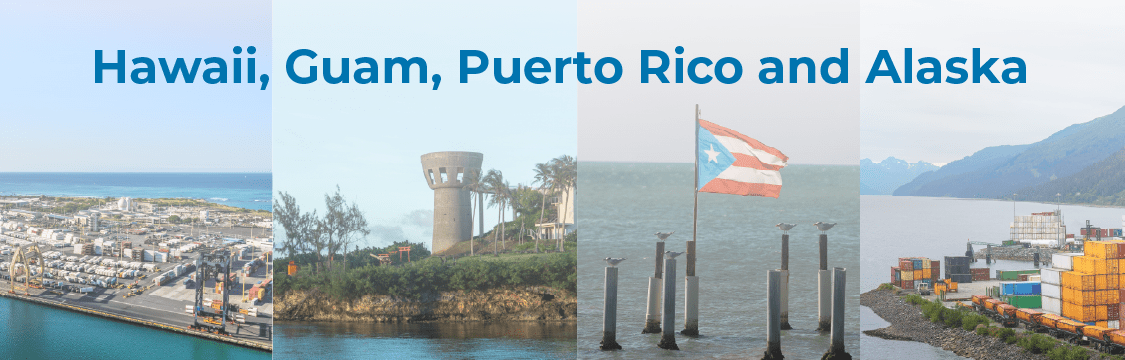
If you’re new to shipping to Puerto Rico, the Jones Act is one of the first things you’ll encounter.
The Merchant Marine Act of 1920 — commonly called the Jones Act — requires that all cargo moving between U.S. ports be transported on vessels that are U.S.-built, U.S.-owned, and U.S.-operated. Puerto Rico, as a U.S. territory, falls under this rule.
What does this mean for your shipment?
- You cannot use foreign-flagged vessels to move freight between LA and Puerto Rico
- Carriers serving this route must comply with strict U.S. fleet requirements
- Working with a freight forwarder who knows Jones Act lanes is critical to avoiding costly compliance mistakes
Approved Freight Forwarders has been moving freight in Jones Act markets — Puerto Rico, Hawaii, Alaska, and Guam — since 1991. We know the carriers, the schedules, and the nuances of this route better than almost anyone.
Hacienda Clearance: Puerto Rico’s Unique Customs Process
Unlike shipping between continental U.S. states, freight arriving in Puerto Rico must be cleared by Hacienda — the Puerto Rico Department of Treasury (el Departamento de Hacienda de Puerto Rico) — before it can be delivered.
Here’s what you need to know:
- Goods arriving from the U.S. mainland are not subject to U.S. customs duties
- However, they are subject to an excise tax specific to your commodity type
- Payment is made through SURI, Hacienda’s online portal
- You’ll need standard documentation: a bill of lading, commercial invoice, and an Electronic Export Filing (EEI) if any single commodity’s declared value exceeds $2,500
First time shipping to Puerto Rico? Hacienda can feel overwhelming if you’ve never done it before. Approved’s team guides customers through the documentation process regularly — we’ll make sure everything is in order so your freight clears fast and doesn’t sit at the port.
Container Options for LA to Puerto Rico Shipments
For FCL shipments, Approved works with the following container types:
| Container Type | Best For |
| 20′ Standard | Smaller FCL loads, dense cargo |
| 40′ Standard | General cargo, medium to large volumes |
| 40′ High Cube | Lightweight, bulky freight |
| 45′ High Cube | High-volume or oversized palletized cargo |
| 53′ High Cube | Maximum volume, common for retail |
| Flat Rack | Machinery, construction materials, oversized items |
Non-containerized cargo? We handle that too. Just let us know what you’ve got.
Why LA-Based Businesses Choose Approved Freight Forwarders
Shipping from the West Coast to Puerto Rico requires a freight partner with real experience — not just someone who can book a container. Here’s why businesses across California trust Approved:
Shipping to Jones Act lanes since 1991. Our experience means fewer surprises and better solutions for your supply chain.
Access to multiple weekly sailings. We work with a network of carriers to give you maximum scheduling flexibility — including some of the fastest available options on this route.
End-to-end logistics. From LA-area pickup and warehousing to Hacienda clearance coordination and final delivery in Puerto Rico, we manage the full move.
Real-time shipment visibility. Our online portal gives you live status updates so you always know where your freight stands.
Dedicated account support. You’ll work with a real person who knows your account — not a call center.
“Always a pleasure to work with the Approved Freight Team, whether it be Hawaii or Puerto Rico I can trust that they will get the job done and assist with any questions along the way.” — Joanna O., Approved Freight Customer
Frequently Asked Questions: LA to Puerto Rico Freight


 (626) 723-0722